
Breed Guide
Doodle Grooming: Goldendoodles, Sheepadoodles and Matting
That soft teddy-bear coat is the reason you got a doodle, and the reason it mats so fast. Here's how we keep goldendoodles and sheepadoodles healthy and mat-free after grooming Miami Lakes dogs since 2003.
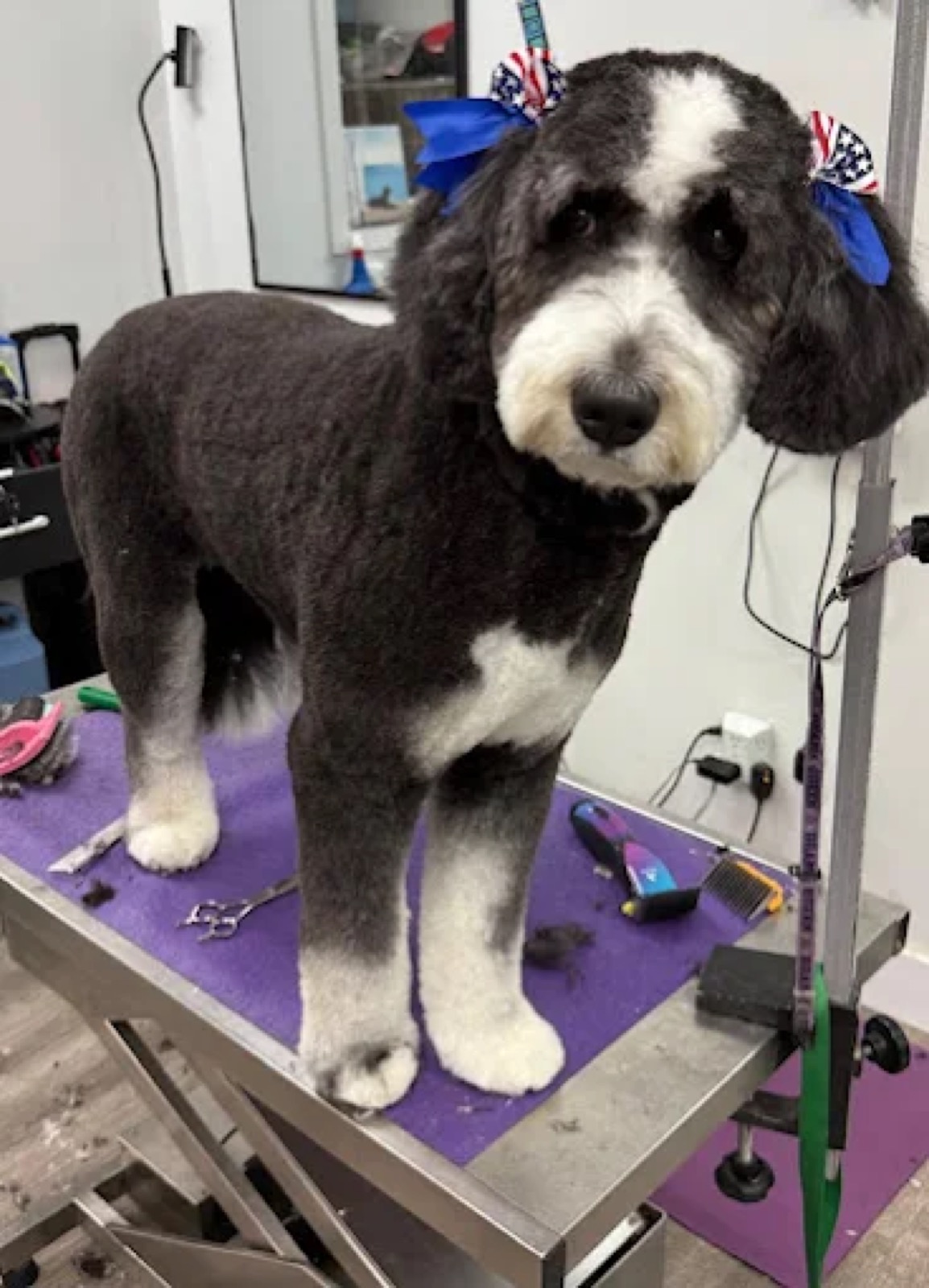
If you own a Goldendoodle, a Sheepadoodle, a Bernedoodle, or any other doodle, you already know two things are true at the same time. That soft, fluffy, teddy-bear coat is the reason you fell in love. And that same coat is more work than almost any other dog you could have picked. We say this with love, because we groom a lot of doodles here in Miami Lakes, and we have seen both the gorgeous version and the heartbreaking version of how this goes.
This guide is the honest, no-fluff version of doodle grooming. We will explain why doodle coats mat so fast, what happens when matting gets out of hand, the schedule your doodle really needs, and the at-home routine that actually keeps the coat healthy between visits. We will also be straight with you about the teddy-bear look and what it costs to maintain in South Florida heat. After more than twenty years on the table, we would rather tell you the truth than sell you a dream that ends in a shave-down.
The short version
Doodle coats are curly, wavy hair that does not shed out, so they mat fast. Plan on a full groom every 4 to 6 weeks and brush to the skin at home several times a week with a slicker and a metal comb. The fluffier you keep the coat, the more upkeep it takes. Skip the routine and the kind choice is often a short shave-down, which nobody enjoys.
Why doodle coats mat so fast
To understand doodle grooming, you have to understand what a doodle coat actually is. A doodle is a cross between a Poodle and another breed, like a Golden Retriever for a Goldendoodle or an Old English Sheepdog for a Sheepadoodle. The poodle side brings that curly, low-shedding hair, which is the whole appeal. But here is the catch most owners are never told at the breeder.
Most dogs shed. The dead hair falls out and ends up on your floor and your couch. A doodle's hair does not shed out the same way. Instead, the dead hair stays trapped in the living curls around it. Add a little movement and a little moisture, and that trapped hair starts to twist and knot. A loose tangle becomes a tight tangle. A tight tangle becomes a mat. And once a mat forms, it pulls in more hair around it and grows. This is why a doodle can look perfectly fine on the surface and be matted down at the skin where you cannot see it.
The friction points are the worst offenders. Anywhere the coat rubs against itself or against gear, mats form first. That means behind the ears, under the collar, in the armpits where the legs meet the body, the backs of the legs, and around the rear. Every harness strap, every collar, every nap on a hard floor adds friction. A doodle that wears a harness on daily walks will often have mats forming right under the straps even though the rest of the coat looks great.
Now add Miami. Our heat and humidity keep the coat damp, and damp hair tangles and holds knots far more easily than dry hair. A doodle that swims, plays in the sprinkler, or just walks in our summer air is working against you all day. This is the reason doodle owners here cannot stretch their schedule the way an owner in a cooler, drier climate sometimes can. If you want the deeper version of how mats form and what they do to the skin, we wrote a whole guide on matting in dogs that pairs well with this one.
What happens when matting goes too far
This is the part we wish every doodle owner understood before it happens, because it is the saddest conversation we have at the salon.
A mat is not just a cosmetic knot. It is a tight ball of hair pulling on the skin every time your dog moves. Picture a clump of your own hair tied in a knot and tugged constantly, day and night. That is what a matted dog feels. Mats also trap moisture and dirt against the skin, block air from reaching it, and hide what is going on underneath. We have shaved out mats and found raw skin, sores, and irritation the owner had no idea were there. In our humidity, a damp mat can turn into a hot spot in a matter of days.
When a doodle comes in heavily matted, brushing it out is not the kind answer, and often it is not even possible. Pulling a comb through a tight mat is painful and can tear the skin. By conscience and by good practice, the humane choice is to shave the coat short, below the mats, so we can start fresh. That means the fluffy teddy bear you love is gone, shaved down to a short, even length, and you wait months for it to grow back. It is not a punishment and it is not bad grooming. It is the only choice that does not hurt your dog. We never enjoy it, and owners never enjoy seeing it. The whole point of a good routine is to make sure it never gets to that.
The grooming schedule doodles really need
Here is the number that matters: a doodle needs a full groom every 4 to 6 weeks. Not every few months. Not "when he looks shaggy." Every four to six weeks, on a rhythm, all year long.
Four weeks is the right call for doodles kept in a longer, fluffier coat, doodles that are very active or swim often, and doodles whose owners cannot brush much at home. Six weeks can work for doodles kept in a shorter cut with a coat that brushes out easily and an owner who keeps up the at-home routine between visits. If you are not sure where your dog lands, start at four to five weeks and adjust. It is always easier on your dog to come in a little sooner than to wait too long and risk the shave-down.
A full doodle groom is more than a haircut. At Paws, every groom includes the bath, blow-dry, nails, ears, anal glands, and teeth, plus the brush-out and the cut itself. Doodles almost always want our Full Service, which adds the haircut and styling, because the coat keeps growing and needs to be shaped and kept to a manageable length. You can see how our tiers work on the services page.
The single best way to stay on rhythm is to not leave it to memory. Life gets busy, six weeks becomes ten, and ten weeks is where doodles get into trouble. That is exactly why we built the Paws Membership, which keeps your doodle on a set schedule so the coat never drifts into matting. More on that below.
The at-home brushing routine that actually works
Here is the hard truth, said plainly. Grooming every four to six weeks is not enough on its own to keep a doodle mat-free. What happens between visits is just as important, and that part is on you. The good news is that the routine is simple once you learn it. The bad news is that a quick once-over with a brush does almost nothing, and a lot of owners think they are brushing when they are really just petting with a brush.
The technique that actually works is called line brushing, and it means brushing the coat in sections all the way down to the skin. Most matting starts at the skin, hidden under a fluffy top layer that looks and feels fine. If your brush only touches the top, you are missing the exact spot where mats form. Line brushing fixes that.
You need two tools, and only two: a slicker brush and a metal comb. Here is how to use them together:
- Start at the bottom of a section, near the skin. Lift the top layer of hair up and out of the way with one hand.
- With the slicker, brush a thin line of hair down and away from the skin in short, gentle strokes. Let the next layer down, then brush again. Work your way up the body in lines, which is where the name comes from.
- After the slicker, run the metal comb through that same section from skin to tip. The comb is your test. If it glides through freely, the section is done. If it snags or stops, there is a tangle the slicker missed, so go back and work it out before it tightens.
- Work calmly, give breaks and treats, and keep it a positive experience so your dog learns that brushing is normal, not a fight.
The metal comb is the honest one. A slicker can skim the surface and make a coat look brushed while tangles hide underneath, but a comb cannot lie. If the comb does not pass from skin to tip, the coat is not done. That one habit, comb-testing every section, is what separates doodles who never mat from doodles who end up shaved.
Brush these zones first, every time
Mats form at friction points, so give the most attention to behind the ears, the armpits where the front legs meet the body, under the collar and harness lines, the backs and insides of the legs, and the rear and tail. If you are short on time, skip the back and brush these zones well. They are where almost every shave-down starts.
How often? For most doodles, line brushing several times a week keeps them comfortable, and daily is even better if you keep the coat long. It does not have to take an hour. Ten to fifteen focused minutes on the friction zones beats a rushed full-body brush that never reaches the skin.
The teddy bear cut and what is realistic in Miami
The "teddy bear cut" is what most doodle owners are picturing when they say they want their dog fluffy. It is a rounded, even, soft look, longer on the body and face so the dog looks like a living stuffed animal. It is adorable, and we cut a lot of them. We also want you to go in with clear eyes about what it takes.
Length and upkeep move together. The longer the coat, the more often it has to be brushed and groomed to stay healthy, full stop. A true long teddy bear coat needs near-daily line brushing at home and a groom every four weeks. There is no shortcut around that. If the brushing does not happen, the long coat mats, and the long coat that mats gets shaved. So the longest version of the look is also the one most likely to end up the shortest.
This is where South Florida changes the math. In our heat and humidity, a very long coat traps warmth and moisture against the skin, which is uncomfortable for the dog and a head start for mats and hot spots. Plenty of our doodle families choose a shorter teddy bear length, maybe half the length they first imagined. It still looks soft and round and very much like a doodle. It is far cooler for the dog in our summers, and it is dramatically easier to keep mat-free between grooms. Honestly, for most active Miami doodles, that medium-short teddy bear is the sweet spot.
One more honest note. If you keep your doodle in a long coat and only come in every couple of months, you cannot also expect to keep the length. When a long coat comes in matted, we have to take it short to be kind. If staying long matters to you, the brushing and the four-week rhythm are not optional. They are the price of the look.
Bathing and drying your doodle
Bathing a doodle has a trap in it that surprises a lot of owners. If you bathe a doodle while it has any tangles, the water tightens those tangles into mats. Wet matted hair shrinks and locks. So the rule is simple: brush and comb the coat all the way out before any bath, never after. A clean coat over hidden mats is still a matted coat, and the bath only made it worse.
Drying matters just as much. Letting a doodle air-dry is one of the fastest ways to create matting, because that curly hair knots as it dries on its own, especially in humid air that never really lets it finish drying. Doodles should be dried with a dryer while you brush the coat out at the same time, which is exactly what we do at the salon. That mix of warm air and brushing is what gives a doodle that full, fluffy, brushed-out look instead of a tight, crimped, half-matted one. At home, if you bathe between visits, dry and brush together rather than letting your dog drip-dry on the couch.
On frequency, doodles do not need frequent baths to be healthy. Over-bathing strips the natural oils and dries the skin. What keeps a doodle clean and comfortable is the brushing routine and the regular professional groom, not constant baths.
What to tell your groomer
A great doodle groom is a partnership, and a few clear words at drop-off make a big difference. Here is what helps us give your dog exactly what you want:
- Name the length in real terms. "Short and easy," "medium teddy bear," or "as long as you can keep it" all mean something to us. If you can, show a photo of the length you love. "Just a trim" means different things to different people, so a picture saves everyone the guesswork.
- Be honest about home brushing. Tell us truthfully how much you brush. There is no judgment, and it genuinely changes our recommendation. If brushing is not going to happen, a shorter cut keeps your dog comfortable and mat-free, and we would rather set you up to win.
- Tell us about the lifestyle. Swimmer, beach dog, daily harness, sensitive skin, hates the dryer, any of it. The more we know, the better the plan.
- Trust us on matting. If we feel mats at the skin, we will tell you straight. If the kind choice is to go shorter, we will explain why. We are not upselling, we are protecting your dog's skin and comfort.
If your doodle is new to you or new to grooming, just give us a call or message before the visit and we will walk you through it. We do this all day, and we love a good doodle.
The honest bottom line on doodles
Here is the truth we promised at the top. The fluffy doodle look is high upkeep. There is no version of this coat that is long, fluffy, and low-maintenance all at the same time. That is not a knock on doodles, who are wonderful, smart, sweet dogs. It is just the reality of curly hair that grows and does not shed out, living in a hot, humid climate.
But high upkeep does not have to mean stress or expensive surprises. It just means a rhythm. Brush to the skin a few times a week, hitting the friction zones, with a slicker and a comb. Come in every four to six weeks for a full groom. Keep the length realistic for your life and our weather. Do those three things and your doodle stays soft, comfortable, and mat-free, and you never have to face a shave-down. Doodle coat care has a lot in common with poodle care, so if you want to go deeper on cuts and coat types, our poodle grooming guide is a useful companion read.
We groom a lot of Miami Lakes doodles, and the happiest doodle families are the ones on a set schedule. That is exactly what our Paws Membership is built for. It keeps your doodle on a regular rhythm so the coat never drifts into matting, spreads the cost into one simple monthly plan instead of surprise bills, and includes a discount on boarding for member families. For a coat that genuinely needs consistent care, it is the easiest way we know to stay ahead of the matting.
Frequently asked questions
How often do doodles need to be groomed?
Most doodles need a full groom every 4 to 6 weeks. Their curly, wavy hair does not shed out on its own, so loose hair stays trapped and mats form fast. A consistent 4 to 6 week rhythm keeps the coat soft and prevents painful shave-downs.
Why does my doodle's coat mat so easily?
Doodles are a cross between a poodle and another breed, so the hair is curly or wavy and keeps growing instead of shedding out. Dead hair stays tangled in the curls, and friction at the collar, armpits, and behind the ears twists it into mats. In Miami's humidity, that happens even faster.
Can I keep my doodle in a long teddy bear cut?
Yes, but the longer the coat, the more brushing it needs. A true teddy bear cut means brushing to the skin most days at home and a groom every 4 weeks. In South Florida heat and humidity, many owners choose a shorter teddy bear length that still looks soft but is far easier to keep mat-free.
What is the best brush for a doodle?
You need two tools: a slicker brush and a metal comb. Use the slicker to line brush down to the skin in sections, then run the metal comb through to check for any tangles you missed. If the comb does not glide from skin to tip, the coat is not fully brushed out yet.
Keep your doodle soft and mat-free
We've been grooming Miami Lakes doodles since 2003. Bring yours in and we'll set the right length and rhythm for their coat, our weather, and your routine.